
How It’s Made
Every Brickabilities mosaic follows the same disciplined process — part engineering, part craft — refined over more than a hundred pieces. Here’s what happens between a photograph and a finished wall piece.
- 01Source
Choosing an Image
Every piece starts with a reference image — a character, a portrait, a scene chosen for how it will read at scale and from a distance. Not every image survives translation into a modular grid; part of the selection process is recognizing which ones will still feel alive once broken into thousands of individual studs.
- 02Scale
Scaling & Grid Mapping
The image is mapped onto a stud grid built from 16×16 and 32×32 baseplate units — the structural system behind every mosaic, from a small test piece up to monumental, multi-baseplate works like Batman & Joker at 82,944 elements.
Resolution and physical size are decided together here: more baseplates means more visual resolution, but also more build hours and structural planning.
- 03Translate
Digital Preparation & Color Substitution
Working in Adobe Photoshop, the image is translated stud-by-stud into a limited palette of real LEGO® colors — a constraint, not a limitation. This digital pixel map becomes the permanent design record for the piece, archived long after the physical build is complete.
- 04Blend
Optical Color Blending
This is where the real craft lives. Because the LEGO® color palette is finite, tones that don’t physically exist — metallics, glow, deep shadow — have to be simulated through adjacency, contrast, and density instead of literal color matching.
- 05Build
Physical Construction
Each baseplate is assembled by hand from the digital plan, one stud at a time. Large works are built in sections and later joined — a process that keeps even the most ambitious pieces structurally sound and transportable.
- 06Mount
Frame Engineering & Mounting
Every finished mosaic is set into a custom-engineered aluminum frame with a magnetic mounting system — designed in-house so pieces stay secure and perfectly flat on the wall, without ever compromising the clean presentation of the artwork.
A discovery along the way
Colors that don’t exist, until they do
Through years of building, certain color combinations turned out to read as things they technically aren’t — tan, white, and yellow placed together, for example, resolve to the eye as a warm gold or metallic surface, even though no metallic element is used. Effects like this — colors that vibrate, blend, or seem to glow — have become a defining part of how Brickabilities mosaics create depth and light using only solid plastic elements.
- Tan
- White
- Yellow
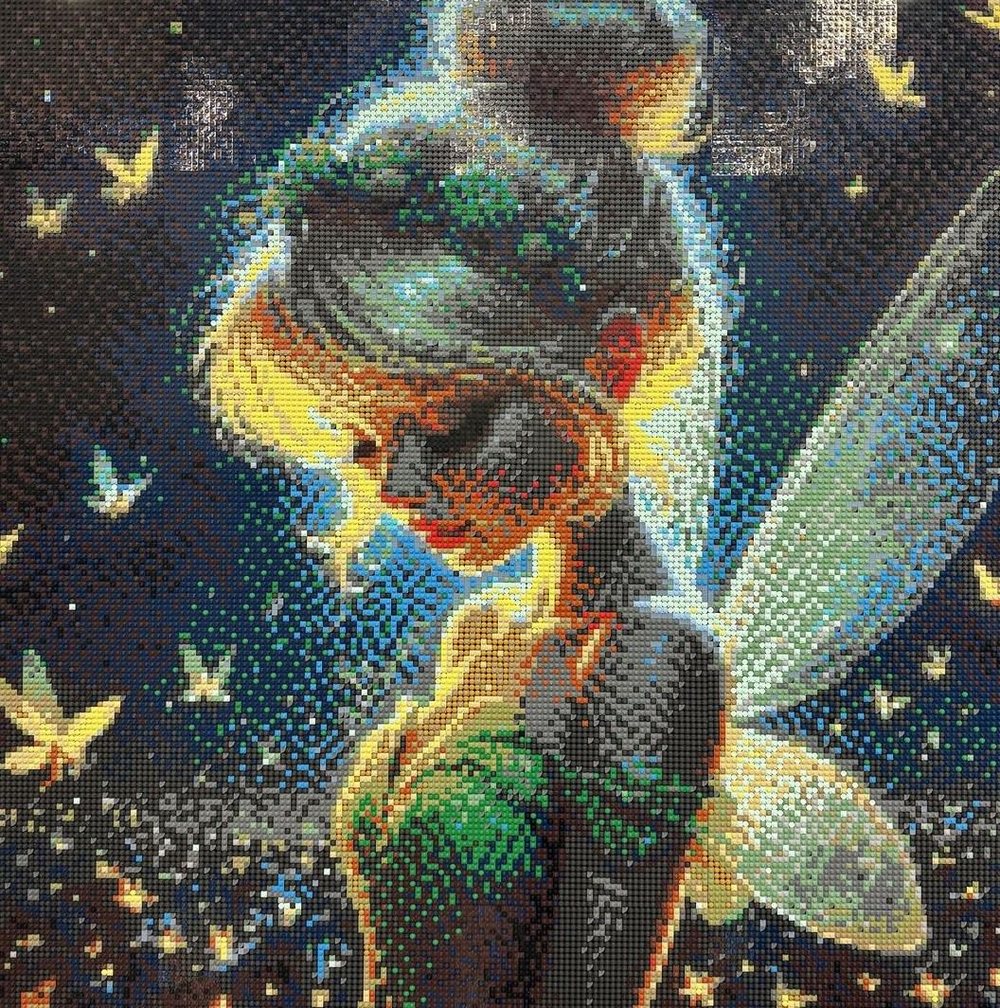
By the numbers — case study
Perception of Light
Tinker Bell reinterpretation · 60.47″ × 60.47″ · 36,864 elements · 2025
A build-hours breakdown for one large-format piece, from first sourcing the image to a mosaic hanging securely on the wall.
| Image selection & sourcing | ~1 hr |
|---|---|
| LEGO® parts ordering | ~1 hr |
| Color mapping & palette translation | ~2 hrs |
| Photoshop mosaic construction | ~54 hrs |
| Physical assembly (36 baseplates) | 90–108 hrs |
| Aluminum frame construction | ~4 hrs |
| Magnetic mounting install | ~4 hrs |
| Estimated total | ~130–140+ hrs |