Contemporary mosaic artist · Oregon, USA
Nathan Burke is an Oregon-based contemporary mosaic artist whose work explores perception, nostalgia, and the relationship between image and material. Working under the studio name Brickabilities, he creates one-of-one mosaics using LEGO® elements, transforming one of the world’s most recognizable objects into large-scale works that reward both distance and close observation.
From across a room, Burke’s mosaics often resemble printed posters or paintings. As viewers move closer, those familiar images dissolve into thousands of individually placed elements, revealing a landscape of color, texture, geometry, and light. That transition — from recognition to discovery — is central to his practice.
Raised in Oregon by a father and grandfather who were both carpenters, Burke developed an early appreciation for craftsmanship, tools, and building with his hands. He spent more than two decades leading operations within the luxury automotive industry for brands including Audi, Porsche, Mercedes-Benz, BMW, Lexus, Land Rover, and Volvo. Managing complex systems, quality standards, and large teams reinforced a disciplined, methodical approach that now shapes his artistic process. Every mosaic is planned, engineered, and assembled with the same precision expected in high-performance environments.
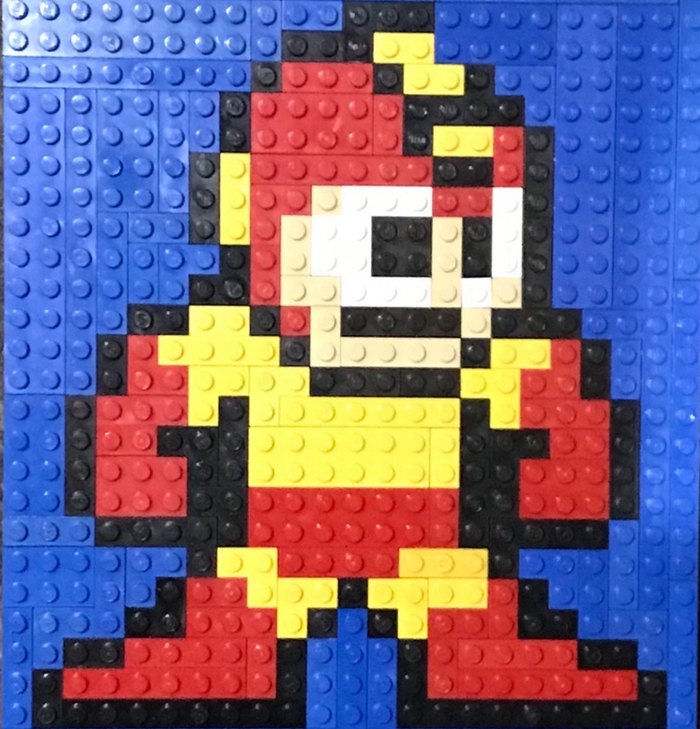
The origins of Brickabilities trace back to an idea for a LEGO-themed café where original creations and custom-built displays would surround visitors. While imagining how to treat the walls, Burke began experimenting with mosaic artwork, first creating an 8-bit Mega Man in 2021. What started as playful pixel art quickly evolved into a focused investigation of color, shading, and perception.
As projects grew in ambition, Burke refined techniques that define his work today. Working within a limited LEGO® color palette, he developed ways to achieve depth, warmth, and realism through optical blending — using subtle combinations of tan, white, yellow, gray, and other tones to suggest metallic surfaces, dramatic shadows, and luminous highlights that are not literally present. Early mosaics became 20 × 30 inch works inspired by classic movie posters, then expanded into larger formats built on modular baseplate systems.
To support these pieces, Burke designed a custom aluminum framing and magnetic mounting system, allowing his mosaics to remain secure and rigid while maintaining a clean, professional presentation. Each original is digitally archived through a pixel-mapped process in Adobe Photoshop, preserving both the design and a detailed record of its construction.
Burke has since exhibited original works annually at Bricks Cascade, the Pacific Northwest’s largest LEGO convention, presenting increasingly ambitious pieces. Highlights include Iron Man and Tinker Bell, each five feet square and composed of 36,864 elements, and Batman & Joker (2026), a 7.5 × 7.5 foot mosaic made from 82,944 LEGO® elements. From a distance, viewers often mistake these works for printed posters; up close, they encounter an intricate construction of individual components.
Although pop culture offers familiar subjects, Burke’s deeper interest lies in transformation — how images change as viewers move through space, how color shapes emotion, and how texture alters perception. Nostalgia functions as an entry point, but curiosity and wonder sustain the experience, as children react with excitement and adults pause to understand how the works are made.
Looking ahead, Burke plans to pursue increasingly monumental installations inspired by architecture, nature, and enduring cultural imagery, challenging expectations of what can be achieved with a modular medium while remaining grounded in craftsmanship, engineering, and the joy of building.
Artist statement
Brickabilities exists to transform one of the world’s most recognizable materials into experiences that inspire curiosity, nostalgia, and wonder through color, texture, and scale. Every piece explores how perception changes with distance, using a familiar material to turn recognition into discovery.